Home        About        Adventure Education          Resources for Students        Parent Resources       Information

Thursday, April 12, 2018

Standing Firm on Consequences

Last week, I wrote about using consequences rather than punishments when working with children. This week I want to address the hardest part of all of this - standing firm on the consequences you give. It can be so difficult for the adult to watch the child living with the consequences of their actions. They are often genuinely very sorry and upset about how things turned out for themselves or they are promising to "never do this again" and begging you to drop the consequence. Often at this point, many parents can see that the "child has learned the lesson" and will sometimes feel like the consequence is not necessary. This is when you need to stay strong and allow your child to deal with the consequences. It will make all of the difference for your family later. As your child grows they will need to be able to make good decisions and the consequences of a bad decision get much bigger as they grow. It truly is best to let them learn how to make decisions and live with the consequences now so that they don't have to learn when the stakes are higher.

A few examples:
  • When your child forgets to bring back their library books on library day, don't run back home to get the books for them. Yes, you want them to have good books to read but you also want them to feel the natural consequence of needing to wait a week to get new books.
  • When your child refuses to wear a coat and it is cold outside, let them feel the cold and wish that they had made the choice to wear a coat. (Of course, you will surreptitiously check the temperature to make sure that this is safe for your child. Only very rarely will the temperatures merit you stepping in.)
  • When your child refuses to get dressed on time for school, don't argue, just bring them to school in their pajamas.
  • When your child forgets to pack their afternoon snack, don't run one up to school for them. They will be just fine without it, perhaps just a little hungrier when they get home from school.
  • When you are going to walk to the park with your children and one child just won't get ready, leave that child at home with the other parent or a neighbor (if you can) and take the other children. No need to make a big fuss, just go ahead and go without the child who won't get ready.
  • Don't give warnings. If your child is misbehaving when you are out somewhere simply tell them that you will have to leave if they don't stop. Then if they don't stop the behavior, leave without saying a word.
It is hard to watch your child cry or "suffer the consequences" but if you help them learn these lessons while the consequences are smaller (even though it doesn't feel like it at the time), you will all be much happier in the end.

Here is the secret, we all mess this up all the time. The good news is that your child will give you another opportunity to practice these new parenting/teaching skills again and again. Remember, we can do hard things.

For more stories and ideas, check out the short articles below:
How Failure Can Lead to Success
Guiding Kids to Own and Solve Their Problems
Learn the ABC's for Training Kids to Do Chores

Wednesday, April 11, 2018

Math Standards for First Grade

This is part two of the math post that I started last week. This time I will simply share a long list of skills that students learn in first grade math. I will try to put them in parent-friendly language.


First Grade Math Skills
  • Count starting at any number less than 120.
  • Read and write numerals up to 120.
  • Understand place value including breaking a two-digit number into tens and ones.
  • Compare 2 two-digit numbers using <, > and =.
  • Compare 2 groups of objects using terms like "this group has 3 more" or "this group has 6 less".
  • Adding a two-digit number and a one-digit number. 25 + 4 = 29
  • Adding a two-digit number and a multiple of ten. 32 + 20 = 50
  • Identify coins and their values.
  • Find the value of groups of two coins or more.
  • Mentally find 10 more or 10 less than any two-digit number.
  • Subtract multiples of ten (10-90) from numbers between 10 and 90.
  • Use addition and subtraction within 20 to solve word problems.
  • Solve word problems that call for addition of three whole numbers whose sum is less than or equal to 20.
  • Add and subtract within 20 using multiple strategies. (Including all the types of problems I mentioned last week.)
  • Demonstrate fluency for addition and subtraction within 10. (Fluency means quickly and accurately finding the answer to problems. It can mean memorizing them but it can also mean solving them quickly using a variety of strategies. Within 10 means that the answer to the problems are between 0 and 10.)
  • Add and subtract three numbers.
  • Understand the meaning of the equal sign. 6 = 6, 7 = 8 – 1, 5 + 2 = 2 + 5, 4 + 1 = 5 + 2.
  • Understand (but not name) properties of addition and subtraction. Examples: If 8 + 3 = 11 is known, then 3 + 8 = 11 is also known. (Commutative property of addition.) To add 2 + 6 + 4, the second two numbers can be added to make a ten, so 2 + 6 + 4 = 2 + 10 = 12. (Associative property of addition.)
  •  Organize, represent, and interpret data with up to three categories.
  • Ask and answer questions about the data in a graph or chart.
  • Learn the various attributes of shapes.
  • Build and draw shapes.
  • Put two or more shapes (either 2D or 3D) to create another shape.
  • Halves and fourths of shapes or groups of items.
  • Order three objects by length; compare the lengths of two objects indirectly by using a third object.
  • Tell and write time in hours and half-hours using analog and digital clocks.


Then there are also the Standards for Mathematical Practice:
  • Make sense of problems and persevere in solving them.
  • Reason abstractly and quantitatively.
  • Construct viable arguments and critique the reasoning of others.
  • Model with mathematics.
  • Use appropriate tools strategically.
  • Attend to precision.
  • Look for and make use of structure.
  • Look for and express regularity in repeated reasoning.


I may have left off a few bits and pieces of some of these but this will give you a good idea of what your child is working on in first grade math. If you would like to read the full version of these standards or some parent versions, please check out the links below.

Colorado First Grade Math Standards
Colorado First Grade Math Standards for Parents
Standards for Mathematical Practice for Parents 


Tuesday, April 10, 2018

Scholastic Branches Book Series

Many students in our crew are ready for the books in the Scholastic Branches series. These books are very appealing to readers in our crew. Click here for the link to the Scholastic Branches site for more details about each book series. I have included photos of the site below to pique your interest. Ask your child which books they are interested in. Most of these are also available at the public library.


Monday, April 9, 2018

Looking for a Good Read Aloud?

I have begun reading chapter books aloud to the crew in addition to continuing to read picture books. Reading aloud is fun and builds comprehension skills and vocabulary. We recently read Ready Freddy: Tooth Trouble by Abby Klein, the first book in a large series of books. The books in this series are so appealing to first graders. In Tooth Trouble, Freddy is the only one in his class who hasn't yet lost a tooth. He is so distraught about this that he creates and carries out several plans to try to make one of his teeth fall out. First graders can really identify with this theme. This illustrator also provides readers with the challenge of finding the word "fin" in every illustration. (Freddy is a shark lover so "fin" is one of his favorite words.) While this book is a "chapter book", it is written at a level that would be "just right" for about one third to one half of the students in our crew. So, many will be able to read the books in the Ready Freddy series on their own. Others will enjoy them as a read aloud.


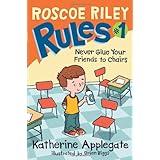
Our current read aloud is Roscoe Riley Rules #1: Never Glue Your Friends to a Chair by Katherine Applegate.   The books in this series are all tales of how Roscoe ended up in the timeout chair - nothing outlandish, just his mishaps and mistakes that will feel familiar to most first graders. In this book, Roscoe is trying hard to help his teacher, a first year teacher, manage the behaviors in his class. His plans don't always work the way that he hopes that they will often with very funny results. Ask your child to tell you about this book.


Our future read alouds will probably include Gooney Bird Greene, Clementine,  The Dragon Masters, Anna Hibiscus and more - depending on our timing.

All of these books are available at the Douglas County Public Library so check some out on your next visit. Happy Reading!

Important Dates
Library - Tuesdays are check out only days for small groups and Fridays are whole crew library time. Be sure to bring back any books that you have finished with by those days if you would like to check out new books.


4/4 - 4/9 Douglas County School District's Art Show
4/9 - 4/13 State Testing for Grades 3 - 6
4/16 - 4/19 State Testing for Grade 5 only
4/19 Spring Voyage to Castlewood Canyon
4/20 No School
4/28 Outdoor Learning Environment (OLE) Work Day
5/9 Renaissance Art Museum Walk 4:00 pm
5/16 - 5/17 Student-Led Conferences for First Grade
5/23 Third Grade Showcase Portfolios 1:15 pm
5/28 No School
5/30 Sixth Grade Showcase Portfolios 1:15 pm
6/5 Sixth Grade Closing Circle 6:30 pm
6/6 Last Day of School - All School Drum Circle at 9:00 am

Friday, April 6, 2018

Katie Woo, Pedro and Mr. Putter

I brought in a new series of books for us to explore - the Katie Woo series. Katie Woo is a series of early chapter books about a first grade girl who has many of the same adventures and problems that our crew has - being bossy, losing a tooth, going camping, having the flu and more. To learn more about the Katie Woo series of books, click here. (To view the video below, you will need to go directly to the blog.)


One of Katie's best friends is Pedro. Pedro now has his own series of books and I brought some of those in for the crew to enjoy, too. Pedro doesn't have his own video about his book series yet. He does have some great adventures including collecting bugs, solving mysteries, playing soccer, and learning karate. To learn more about the Pedro series of books, click here.


The other series that I brought in was Mr. Putter and Tabby series, by Cynthia Rylant, the author of the Henry and Mudge series and Annie and Snowball series. This series is about the adventures of a retired gentleman named Mr. Putter and his cat Tabby. I am always surprised by how much first graders enjoy this series. I think they see Mr. Putter as a "grandpa" figure and enjoy reading the stories of his adventures. Many of his adventures include his next door neighbor, Mrs. Teaberry and her dog, Zeke, so the books can sometimes feel like Henry and Annie from the previous series have grown up. Again, this series has very sweet stories that first graders enjoy.


Be sure to check some of these books out on your next trip to the public library!

Thursday, April 5, 2018

Addition and Subtraction

I set out to write a post for you today about the math standards for first grade but as I was gathering my thoughts, I realized that I needed to break this information down into two posts (maybe more). Today I am just going to focus on addition and subtraction problems because there are several types of each of these and some types are easier for students to understand than others.

Result Unknown - The first type of addition and subtraction problem is the result unknown problem. This type is what we generally think of when we think of basic addition and subtraction problems. This is the type of problem where we need to find the "answer". Most kids do relatively well understanding the concepts of this type of problem. Here are a few examples:

4 + 3 = 7
7 - 5 = 2

or

Bryan has 7 shells. His sister gave him 9 more shells. How many shells does Bryan have now?

Jill has 12 books. She gave 7 books to her crew. How many books does Jill have now?

Change Unknown - In this type of problem, we know the "answer" but have to figure out what happened to the original amount. You might think of this as the middle number in a problem is missing. This type of problem is much more difficult for most students. Here are a few examples:

3 + ? = 11
13 - ? = 8

or

Bryan has 5 shells. His sister gives him some more shells.  Now Bryan has 9 shells. How many did his sister give him.

Jill has 14 books. She gave some books to her crew. Now Jill has 5 books. How many did she give to her crew?

Start Unknown - The next type of problem is the type where you need to figure out the original amount. Again, these are typically more challenging for many students. Here are a few examples:

? + 7 = 13
? - 4 = 8

or

Bryan has some shells. His sister gives him 7 more shells. Now Bryan has 10 shells. How many did his sister give him?

Jill has some books. Her crew gives her 9 books. Now Jill has 17 books. How many books did Jill's crew give her?

Comparison - In comparison problems, you are comparing two amounts. These are often very challenging for students. The language involved is very complex and difficult for students to break into comprehensible pieces. Here are a few examples:

James has 6 toy mice. Joy has 11 toy mice. How many more mice does Joy have than James?

James has 6 toy mice. Joy has 5 more toy mice than James. How many toy mice does Joy have?

Joy has 11 toy mice. She has 5 more toy mice than James. How many toy mice does James have?

So often we conclude that a child has mastered addition and subtraction when they can do the result unknown type of problems and then we are surprised when they struggle with these other types. We often take the numbers out of these problems and then as we slowly begin to understand the situation, we add the numbers back in. One resource I use for numberless word problems is here.

You can help by telling your child math stories about the situations you find yourselves in every day. Ask your child to solve these stories and be sure to vary the type of stories that you create. Allow your child to use pennies, fingers, drawings or whatever they need to help them solve the problem. Keep it light and fun and just do one or two of these every now and then.


Wednesday, April 4, 2018

Consequences versus Punishments

As you know, Renaissance is a Love and Logic school. You may not know that we are also a Responsive Classroom school. Both of these practices inform how we interact with our crews all day, every day. Love and Logic comes into play more when issues and problems arise and Responsive Classroom impacts everything we do with our crews from academics to social skills to classroom environment.

Both of these philosophies share the belief that consequences, not punishments, are a better way to help children learn, develop and solve problems. It is hard to explain the subtle difference between consequences and punishments but I am going to give it a go. Consequences are related to the behavior and include an attempt to help the child learn from their mistakes. Children may end up feeling bad about their behavior but the adult is not focused on those feelings but rather on teaching the child how to fix the problem and how to prevent it in the future. Punishments are often not related to the behavior and often include a desire to make a child feel bad or sorry for what they have done.

Here is an example: If a child makes a big mess in the bathroom with wet toilet paper and wet paper towels (yes, this is based on a true story), a consequence would be to have the child talk about the decision to do this and how it impacts others - the custodian, other children who have to see or avoid the mess - and then to have the child decide how to fix this problem. A logical consequence would be to have the child clean up the mess and maybe talk with the custodian about how this impacted him - hopefully the child would come up with this consequence on their own but many often need a little help with this. A punishment would be to say to the child, "You will miss recess since you chose to make a mess in the bathroom." Missing recess is not related to the behavior at all and doesn't really teach the child to think about what the problem was and how to fix it. (This doesn't mean that students never miss a recess. They might if they are being unkind or unsafe at recess. Then they might be asked to walk with a teacher so that the teacher can be sure that they are safe.)

Children will often feel relieved that they were able to help solve the problem. Sometimes they will feel like they "got off easy". For example, we had two students who were always tussling, playing, messing around with each other as we walked down the hall as a crew. I told them that I was worried that they were going to hurt one of their other friends and that they should stop. They did it again and I told them that I was going to have to do something about this but that I needed to think about it for a while first. I left them wondering/worrying about what might happen until the next day at school. Having had this problem many times in my teaching career, I had tried various things that didn't really work - asking the involved students not to stand next to each other (which led to them putting some poor unsuspecting child in between them and in the middle of the tussling), having one student lead the line and one end the line (both of these positions are like rewards/prizes when you are in first grade). I did speak with the students about the problem but their ideas were the ones I had tried in the past with other students that didn't work out so well so I told them that I had a different plan to try. I told one student that he had to always be the 6th person in line and the other student that he had to be the 12th student in line. I could tell by the look on their faces that they thought this wasn't a punishment. It wasn't, it was simply a way to solve the problem. It also forced the rest of the crew to practice being flexible. They had to allow these boys to "cut" them in line. They all soon learned that this wasn't actually a problem and that we all got to where we were going much more quickly without all of the stops to solve problems.

Sometimes, though, students will feel terrible about a natural consequence. You know that I give the students a large ziploc bag to carry books to and from school in order to keep the books safe and dry. When a child forgets to return their bag and the books that were inside, I simply say, "Bummer. Hopefully you will remember to bring your bag tomorrow so that you can take some new books home to read." That is it, but for some kids, this feels horrible. They feel sad that they can't bring home books to read that day and they feel sad that I was disappointed ("Bummer"). One little girl didn't want to come in to the building one day because she didn't want to tell me that she had forgotten her book bag. Her mom asked her what would happen and she said, "Ms. Jill will say bummer!" I just say bummer in the most matter of fact way, too.

The examples above are all from very minor issues so to be clear, there can be much more serious consequences for more serious issues. Even then, we work hard to use consequences rather than punishments.

Hopefully this helps a little with understanding how we interact with kids at Renaissance. It also works very well at home, too. If you would like to read more about this, check out the links below. Most of them are very short but they are packed with good ideas.

Punishment vs. Logical Consequences - Responsive Classroom
Why You Don't Need a List of Perfect Consequences - Love and Logic
Is "I'm Sorry" Enough? - Love and Logic
Building Survival Skills for the Real World - Love and Logic

The Responsive Classroom Approach - Information for Parents